I hate to admit it, but my mind wanders.
In the course of a day, I become interested in a number of things, so bear with me...I'm pretty sure I'll post something of interest some day....
Here are just a few really weird and inappropriate advertisements I have come across over the last couple of years as I troll the internet for vintage images. Enjoy or gag...as you so desire.
You can not make this stuff up...
Tuesday, June 23, 2015
A Few Facts About Greeting Cards — From All Of Us At NPR
With Father's Day this weekend, many Americans are bound to make last-minute trips to find that perfect humorous card for good ol' Dad.
Not my roommate. She has a stockpile of greeting cards that she buys not for a specific occasion, not to send to a particular person. She purchases cards just because.
Or maybe you buy cards like my mother. "Remind me to get a card for Aunt Tracy," she'd say as we strolled into the mall when I was a kid. Then she would spend what felt like hours perusing the shelves, looking for a card with the perfect touch of corny.
But whatever your card-choosing strategy, here are five things you may not have known about greeting cards.
1. Americans buy a ton of greeting cards
While greeting card sales have gradually declined since the advent of e-cards and other digital modes of communication, Americans still buy about 6.5 billion cards each year. The most popular card-giving occasions are for birthdays and Christmas, according to the Greeting Card Association. Women buy 80 percent of all greeting cards.
2. Pets' names often appear on cards
You've probably received many cards with messages like this: Happy birthday! Love, Mark, Joan, Bobby, Susie and Taffy. Many people view their pets as if they were part of the family, so it makes sense they would include pet names on cards. An American Animal Hospital Association survey found that 70 percent of people include their pet's name on greeting cards.
3. The name "Hallmark" was inspired by goldsmiths
The ancient Chinese would send cards to celebrate the New Year, as did the Egyptians, who would mark papyrus scrolls with messages. In Europe, people began giving handmade paper cards for Valentine's Day around the early 1400s. But cards really took off in the 1850s as the printing press made card production quicker and cheaper.
And that little company called Hallmark? The Hall Brothers card company was founded in 1910 by Joyce Clyde Hall and his brother in Kansas City, Mo. They crafted picture postcards for about five years until sales declined, and they began making greeting cards in response to people's desire for more private communication. The word "hallmark" was used by goldsmiths to describe a "mark of quality." It fit perfectly, and the company name was changed in 1928. Hallmark was also the first to display cards on shelves standing up. Before that they were placed in drawers.
4. The Louie Awards recognize the best cards annually
The International Greeting Cards Award Competition, or the Louies, have recognized the best cards each year since 1988. The Louies are named after Louis Prang, a German immigrant who is credited with producing one of the first lines of Christmas cards in the U.S., in 1875. Submissions to the Louies are blind-judged on originality, impact, design excellence, sendability and value, and winners are announced in May during the National Stationery Show (yes, that's a thing) in New York City. The Card of the Year in 2014 featured a picture of a dog with a red velvet cupcake wrapper in its mouth.
5. Millennials reject greeting card technology
Millennials are also eschewing e-cards and seeking a feeling of nostalgia in card-giving. As a result, fancy, often pricey cards from sites such as Etsy are gaining popularity, perhaps in response to digital communication exhaustion. Older generations, however, seem content to send e-cards. Or if you're like my roommate, you love a spontaneous trip to Papyrus.
http://www.npr.org/2015/06/19/415801900/a-few-facts-about-greeting-cards-from-all-of-us-at-npr
Samantha Raphelson
I'm currently cleaning up an "antique" image for a birthday card I'm going to make for my Etsy Shop "The Reimagined Past."
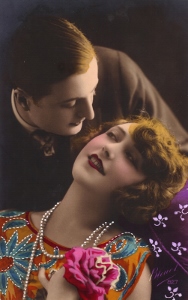
It's a wonderful old french Birthday card.
While looking on the internet to make sure "bonne fete" also means Happy Birthday in french, I sidetracked and found an interesting website, called "Mille Baiseurs" - referencing the note written on the Birthday card. https://millebaisers.wordpress.com/
It literally translates as "a thousand kisses", but is a traditional way to sign a letter "Lots of love" or "XOXO" in French.
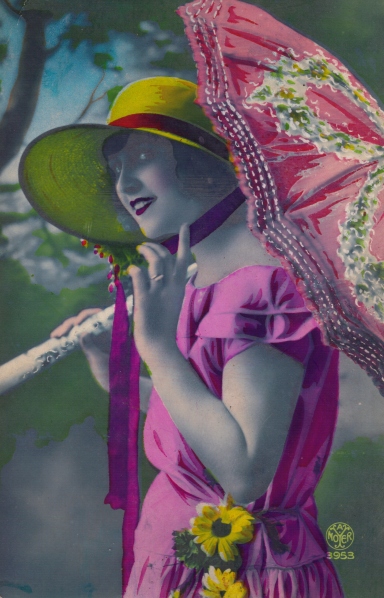
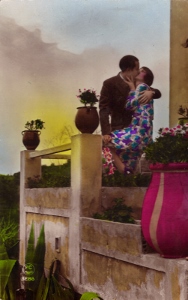
It also refers to a particular genre of postcard - French (usually) postcards from the 1920's, usually of a romantic nature, but they can also be found for a variety of other occasions - New Year's, Christmas, Easter and "come hither" looks! Today they look (in my opinion) pretty kitschy, but they are fun!!
- first three photos were found on the Mille Baiseurs webpage -
Tuesday, May 26, 2015
Jack Fogarty and John MacDonald served with the Army’s 98th Evacuation Hospital in World War II’s Pacific Theater from 1944 to 1945, where they spent “many an hour sitting around in a jungle clearing,” according to Fogarty, who is now 92 and living in Teaneck, New Jersey. The two soldiers developed a tight friendship as they worked and relaxed together.
While stationed in the Pacific Theater in the 1940s, Jack Fogarty wrote letters to his best friend’s wife in Queens, NY, and illustrated the envelopes. All photos courtesy of the National Postal Museum
Fogarty became close friends, too, with John’s wife, Mary MacDonald, who remained home in Queens, New York. Fogarty had met her before he and John shipped out, and he struck up a correspondence with her that lasted until he and John returned home. An amateur artist, Fogarty illustrated his envelopes to show Mary daily life around the camp—jungle hikes, beach swims, evenings in tents under gaslight.
“My drawings were an expression of love for the MacDonalds,” says Fogarty. “I loved them and they loved me in the best of terms.”
The letters sealed a lifelong friendship between Fogarty and the MacDonald family. Mary MacDonald died in 2003; her husband in 2007.
Meg MacDonald, one of the couple’s four daughters, recently donated 33 illustrated envelopes, eight letters and a watercolor made by Fogarty to the National Postal Museum, which is currently exhibiting them online.
Many of Fogarty’s illustrations depict daily life around the evacuation hospital.
We spoke with Fogarty recently about his time in the War, his art and his enduring friendship. An excerpt of our conversation follows.
When did you first meet Mary?
I met Mary in 1943 when John and I were stationed in an evacuation hospital in the Yuma, Arizona desert. She came to visit John in the first few months we were there. All the soldiers went into town whenever we had time off, so I bumped into John with Mary in town one day. John introduced us and that began our friendship. I started corresponding with her after we went overseas, and she was very loyal, a very good friend. Since I was so close with her husband, she liked hearing about my relationship with him and our time in the service. What made you decide to illustrate the envelopes you sent her?
I’ve always drawn—all my life I’ve had a talent to paint. I had another dear friend from high school, a cartoonist, and he and I exchanged letters when we both joined the service. He would illustrate his envelopes, so I would do the same. That started it. Then when I was in the South Pacific Islands in World War II, John started a weekly bulletin just for the 217 men in the evacuation hospital. He did the editorials, and I did the artwork on a mimeograph machine. That got me doing more illustrations, so I started drawing on the envelopes to Mary.
Tell us about the illustrations.
They illustrated what was happening at the time. They showed the places we were at, the fantasies we had. They were an outlet, and I had the talent to make them. And they meant so much to Mary, because they showed her husband’s life while they were separated, and she loved him so much. It’s funny, too, because a lot of the drawings would be considered chauvinistic now—you know, jokes about women and so forth. What was your relationship like with the MacDonalds back then?
It’s difficult to describe, because it’s such an important part of my life. It’s a love relationship. John and Mary were just wonderful, wonderful people. They were friends, and friendship is very important to me. We had the same values, as far as our faith and our family. And John was a mentor to me. I’m a little slow in my growing up, shall we say—I’m still a little naïve. John was a married man, and worldly. He had been a reporter before he joined the service. We would just discuss everything, discuss all the topics that young men would discuss at the time. It was an exchange of values and thoughts and experiences.
A few years ago, Meg MacDonald told you she had found your letters and illustrations among Mary’s things. What was it like to be reunited with them?
I was completely flabbergasted that Mary kept them. But I was flattered. It was a very warm feeling to know that Mary had kept them all these years. It’s strange reading the letters now, looking back on the past. It happened, and yet it’s incredible that it did happen.
Many young people who see your illustrations online will never have known a world without e-mail. What do you hope younger viewers take away from your letters?
My niece is a teacher, and a while ago she has a fellow teacher who invited me in to talk about World War II. I brought souvenirs from the war, my patch, and cap, and pictures, and things from Japan. It was the most rewarding experience. The children were so attentive and interested. They have no idea of the world as I knew it, and yet they were so excited to realize a world they didn’t know. They were learning about something other than Lady Gaga or all these things they need to have today, iPads and so forth. I hope these letters do the same for others.
A Memorial Day Memory: Love From the Pacific Theater
A 92-year-old WWII vet who recently donated his wartime letters to the National Postal Museum reflects on a friendship that lasted a lifetime
On Valentine’s Day a few years ago my friend Sally received a card. She was pretty sure it was from the man she’d been dating for six months or so but she couldn’t be certain because, she realised, in all that time she’d never actually seen his handwriting.
Their communication had all been technological and, she now reflected, less than romantic on account of that. Instead of a bundle of love letters, she had nothing but an intangible collection of texts on her iPhone and a few (entirely lower case) emails. By sending the Valentine card the boyfriend confirmed how remiss he’d been.
Mind you, Sally wasn’t quite Virginia Woolf herself. Searching for writing implements at home she found just a stubby pencil that had fallen into her pocket on a trip to Ikea. “The only thing I actually write by hand now is my shopping list,” she lamented. “When I had to write a really long list at Christmas I practically got RSI from the strain of it.”
Sally resolved to re-engage with the joys of putting pen to paper instead of fingers to keypad. And she’s not alone. It’s a welcome irony of the digital age that as technology advances many seem to be reverting to more old-fashioned methods of communication and record-keeping.
We’re rediscovering the joys of stationery in particular – simple paper and writing products we can touch and smell and keep.
Shopping for stationery is a relatively guilt-free retail therapy.This renaissance made the UK stationery and drawing materials market worth almost £430m in 2012 alone. It’s why in 2011 John Lewis reported a 177 per cent rise in sales of premium stationery, why business is booming at Ryman and Paperchase, why Liberty of London opened a dedicated stationery department with packets of pencils apparently flying off the shelves at £16.95 for six.
It’s also why Smythson has reported annual profits of almost £2.5 million. Even costing £200 a pop, that adds up to an awful lot of calf leather-bound Portobello diaries they’re selling.
The reason? Perhaps it’s relatively guilt-free retail therapy we get from buying things that are actually useful. Perhaps it’s the primitive sensory pleasure induced by choosing and using beautiful things. Or maybe it’s more the potential that new stationery seems to hold – the new Moleskine notebook, which promises to inspire the great novel within us, the empty box files that we tell ourselves will turn us into an organisational genius, the deckle-edged writing paper that will make our letters read more like poetry.
The power we invest in these creative tools can border on the superstitious. “For some reason, I much prefer writing with a black pen than a blue one, and in a perfect world I’d always use ‘narrow feint’ writing paper,” says JK Rowling.
And let’s face it, it seems to work for her.
Perhaps it’s also the fact that so much of our personal history is evident in our stationery. My father died 10 years ago but I still feel moved when I see his address book – the leather cover, pages filled with his backward-slanting italics and crossings out where friends predeceased him.
My introduction to correspondence was the thank-you letter. These were written on my mum’s watermarked Azure Basildon Bond. This came in A5 pads with a ruled sheet to place beneath each page as a guideline. The spacing of the lines was mercifully wide so it was easy to cover a couple of pages which, once folded into their matching envelopes, made a satisfyingly thick missive.
My career as a writer continued when I secured a couple of pen friends via the ads in magazines such as Jackie. Both of my pen friends lived within driving distance, but that wasn’t the point. I’d discovered a range of stationery called Hunkydory with paper in a mouthwatering range of suitably 70s colours – tangerine, crème de menthe, banana yellow – so vibrant that its brightness made up for what I wrote.
I remember the stationery at school better than most of what I learnt there. The shelves in the art room filled with sugar paper that set one’s teeth on edge and which we cut using the enormous guillotine. The ink station where the girls who used proper Parker fountain (as opposed to Paper Mate cartridge) pens filled them up with Quink.
Thirty years on I still receive Christmas cards from a particularly classy school friend, who still uses the latter. Her envelopes are immediately recognisable and it’s become a Christmas highlight when “Emma’s card” arrives. Which is what it’s all about, isn’t it? Being tweeted is never going to make us feel like a million dollars.
We’re unlikely ever to flick back through the pages of our online iCalendars and reminisce about years gone by. So maybe it’s time to invest in that personalised writing set. Smythson here I come.
There might be something waiting for you at Japan’s Missing Post Office
Many countries’ postal systems have a type of “dead letter office” which handles mail that has been inappropriately addressed and could not be sent. In most cases, if the sender cannot be found the messages are destroyed in order to maintain privacy.
The Missing Post Office, on the other hand, welcomes unaddressed post cards and keeps them for eternity if need be until they end up with the rightful owner even if they aren’t alive. The unusual post office opened on the island of Awashima on 5 October and welcome all to come and read their discarded messages of humanity.
■ A work of art
The Missing Post Office was created by artist Saya Kubota as a part of the Setouchi Art Festival around the Islands of the Seto Inland Sea in Kagawa Prefecture. It’s actually a renovated post office which closed down in 1991.
Much of the office remains intact aside from the addition of some art pieces and changes to the sign. The standard 〒symbol which identifies post offices was stylized into a wavy version symbolizing the ocean which carries messages in a bottle – a central theme to the Missing Post Office. The symbol can be seen all around the place including the uniforms of its staff. ■Meet the staff Director – Katsuhisa Nakata
Mr. Nakata was the director of the Awashima Post Office for 45 years until retiring. After serving his community for most of his life he was asked to return as acting director of the Missing Post Office, a post which he accepted with pride. Clerk – Saya Kubota
The creator of the Missing Post Office, Ms. Kubota wanted a place where human thoughts and emotions could accumulate like flotsam on a beach. Only instead of tossing a message in a bottle and possibly losing it to the depths of the ocean (an act which she compares to posting on the internet), the Missing Post Office will protect it and allow it to be found by its rightful owner and anyone else who needs to share that same feeling. ■Inside the office
The main piece of the Missing Post Office is the Drifting P.O. Box. Tin boxes are suspended on standing piano wire all atop a revolving wooden table. Visitors are encouraged to reach into a box and pull out a message. The messages are anonymous but 100% real. They might be written to deceased relatives, unborn children, or even a traffic light. Whatever people were motivated to write down or needed to get off their chest can be found in these boxes.
The following are some sample messages from the Drifting P.O. Box:
“Mother, When you died last summer I didn’t cry. When you were alive it was like we only said horrible and spiteful things to each other… If we met now I think we still would… But a year has passed and I have only loving memories from childhood left. I have when we made pudding together. I have when we read books. I have when you bought me my piano. That was the happiest.”
_________________________________________________________________ “To my future grandchild, When will you arrive? The sooner the better, come on and be born! I can’t wait to finally do for you everything I couldn’t do for my own kids.”
_________________________________________________________________ “Actually, I was hoping to do the folk dance at school with you. My heart was pounding with excitement as our turn together was coming around soon but… just before it happened, the song cut off. Since then several autumns have gone by. What might have happened to you by now?”
■How to send to the Missing Post Office
If you’d like to send a message to the Missing Post Office, just write it on a post card and send it to the address listed below without including the name of the recipient, your own name or address. Only post cards though. They will not open envelopes since the message is not meant for them.
In the case that your message is too long to fit on a post card, then they encourage you to use several. Whoever it’s meant for should be able to piece it together. Also, in the event that the person who the message is intended for appears at the Missing Post Office, they will be able to leave with it.
Although the Setouchi Art Festival will come to an end on 4 November, it looks as if the Missing Post Office will live on. The 79-year-old Mr. Nakata said he will continue to serve as its acting director.
The autumn is a very nice time to visit the islands of Kagawa Prefecture, and even if conceptual art is not your thing, it’s hard to ignore the raw humanity that can be felt in the Missing Post Office. Information Missing Post Office (Hyoryu Yubinkyoku) 〒769-1108 Hyoryu Yubinkyoku Dome Awashima 1317-2, Takuma Town, Miyoto City, Kagawa Prefecture